What is a hydrocele?
A hydrocele is a collection of fluids around the testicle. A baby can be born with a hydrocele, or a hydrocele can form later in life.
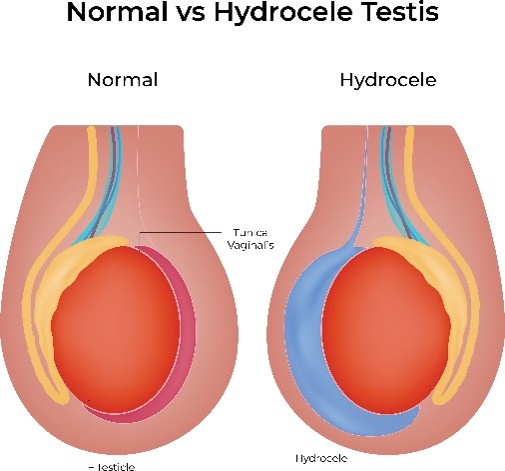
Hydroceles can be either communicating or noncommunicating:
- Communicating hydrocele: The fluid comes in and goes from the scrotum/groin through an opening in the abdominal wall, called a hernia.
- Noncommunicating hydrocele: The fluid remains trapped around the testicle like a water balloon and does not fluctuate.
What are the symptoms of a hydrocele or inguinal hernia?
Symptoms include scrotal and/or groin swelling and depend on if the hydrocele is communicating or noncommunicating:
- For a communicating hydrocele, the swelling comes and goes. There is typically no pain; however, if there is discomfort, this would be a sign that an internal organ may be trapped in the hernia. This may also lead to signs of bowel obstruction, such as vomiting, distension of the belly, lack of bowel movements or gas. All of these are signs of an emergency and would necessitate immediate medical attention.
- For a noncommunicating hydrocele, the swelling is stable. It may gradually improve over time, but it does not fluctuate. There is typically no pain, but if the hydrocele is very large, it may be uncomfortable in older children.
What are the causes and risk factors of a hydrocele?
Causes depend on if the hydrocele is communicating or noncommunicating:
- A communicating hydrocele is typically present from birth but is sometimes identified years later. After the testicle descends into the scrotum during gestation, the tunnel that it travels through can stay open, which is the hernia.
- A noncommunicating hydrocele can be present at birth, or it can appear after a testicular infection or trauma, or it can occur for no reason at all.
How is a hydrocele or hernia diagnosed?
Hydroceles and inguinal hernias are diagnosed by history and physical exam. Occasionally an ultrasound can be useful if the hydrocele is very tense and the testicle discernable.
What are the treatment options for a hydrocele?
Treatment depends on if the hydrocele is communicating or noncommunicating:
- A communicating hydrocele requires surgery to repair the hernia. The procedure lasts about 30 minutes and can be done under general or (in infants smaller than 18 lbs) awake spinal anesthesia. In all ages, the procedure may be done laparoscopically or through a 1-inch open incision. In teenagers, the procedure may require placement of a mesh and can be done with robotically to minimize discomfort and improve time to recovery.
- A noncommunicating hydrocele does not necessarily need treatment if it is not bothersome. Most congenital hydroceles typically resolve on their own within 18 months of life. However, if surgery is selected, the procedure is outpatient and lasts about 30 minutes under general anesthesia.
Why Choose WCM?
The Division of Pediatric Urology at Weill Cornell Medicine, proudly affiliated with Children’s Hospital of New York at NewYork-Presbyterian, provides world-class care to children of all ages, from birth through adolescence, with disorders of the kidney, ureter, bladder, urethral and external genitalia. Our board-certified and fellowship-trained pediatric urologists offer minimally invasive robotic and laparoscopic procedures, complex open procedures and non-surgical management of pediatric urological disorders. Our program is a top Pediatric Urology program in New York City, and NewYork-Presbyterian Children’s Hospital-Columbia and Cornell is ranked among the top 50 pediatric urology programs in the United States by U.S. News & World Report.
Would you like an appointment?
To request an appointment, please call our office at (646) 962-2112 or schedule an appointment with one of our providers online below. Our phone staff are available to help you Monday-Friday, from 9AM-5PM (EST).
Meet our expert providers who specialize in treating Hydrocele: