Read about upcoming changes to UnitedHealthcare coverage.
Vesicoureteral reflux or VUR occurs when urine flows backwards from the bladder up into the ureter and kidney. It can occur in one or both kidneys.
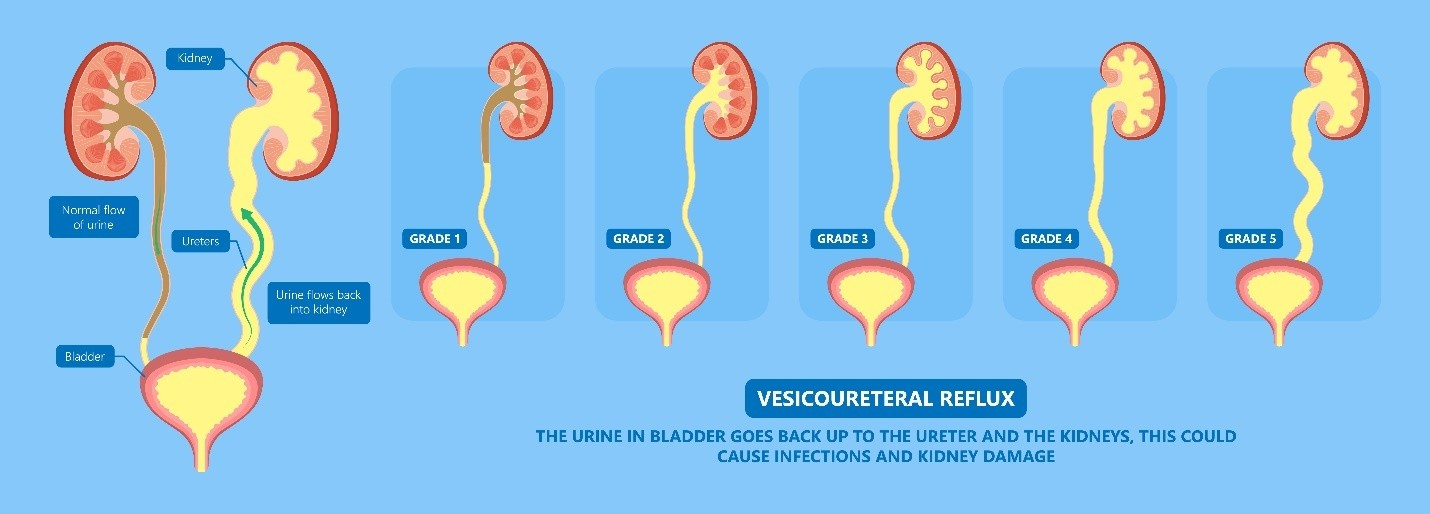
VUR is often identified after evaluation of hydronephrosis, or a swelling of the collecting system of the kidney. VUR is painless, but it can be associated with urinary tract infections of the kidney. The most common sign of a kidney infection is an isolated fever.
VUR can be classified as primary or secondary:
VUR is diagnosed with either voiding cystourethrogram (VCUG) or contrast-enhanced voiding ultrasound (CEVUS). During these tests, a small catheter is inserted into the child’s urethra, and the bladder is filled with a special fluid. Depending on the test, either an X-ray or an ultrasound is used to identify the liquid in the kidneys. If reflux is present, it is graded on a scale of 1 – 5, depending on the severity.
Many children outgrow reflux on their own, though this depends on the severity of the VUR. A daily antibiotic may be recommended to help decrease the risk of urinary tract infection until the child outgrows VUR.
For children with primary reflux where surgery is recommended, options include Deflux, open ureteral reimplantation and robotic ureteral reimplantation. Deflux involves injecting a small amount of a gel-like bulking agent into the entrance of the ureter to make the connection tighter, helping prevent the backflow of urine to the kidney. This procedure is done endoscopically without any incisions and is done as an outpatient. It is appropriate for treatment of low grade (1 – 2) of VUR. Formal surgery can also be done to tighten the connection between the bladder and the ureter. This can be done as either an open or a robotic-assisted laparoscopic surgery. Both can be done as either an outpatient procedure, or families may elect to spend a night in the hospital. Formal surgery is an option for all grades of primary reflux. For secondary reflux, surgery is typically avoided, and the primary cause (constipation, voiding dysfunction, elevated voiding pressures, outlet obstruction) is addressed instead.
To request an appointment, please call our office at (646) 962-2112 or schedule an appointment with one of our providers online below. Our phone staff are available to help you Monday-Friday, from 9AM-5PM (EST).
Meet our expert providers who specialize in treating Vesicoureteral reflux: