Read about upcoming changes to UnitedHealthcare coverage.

Compared to earlier versions of the food pyramid issued in the 1990s, the new pyramid looks upside-down, with the widest part on top and the narrowest at the bottom.
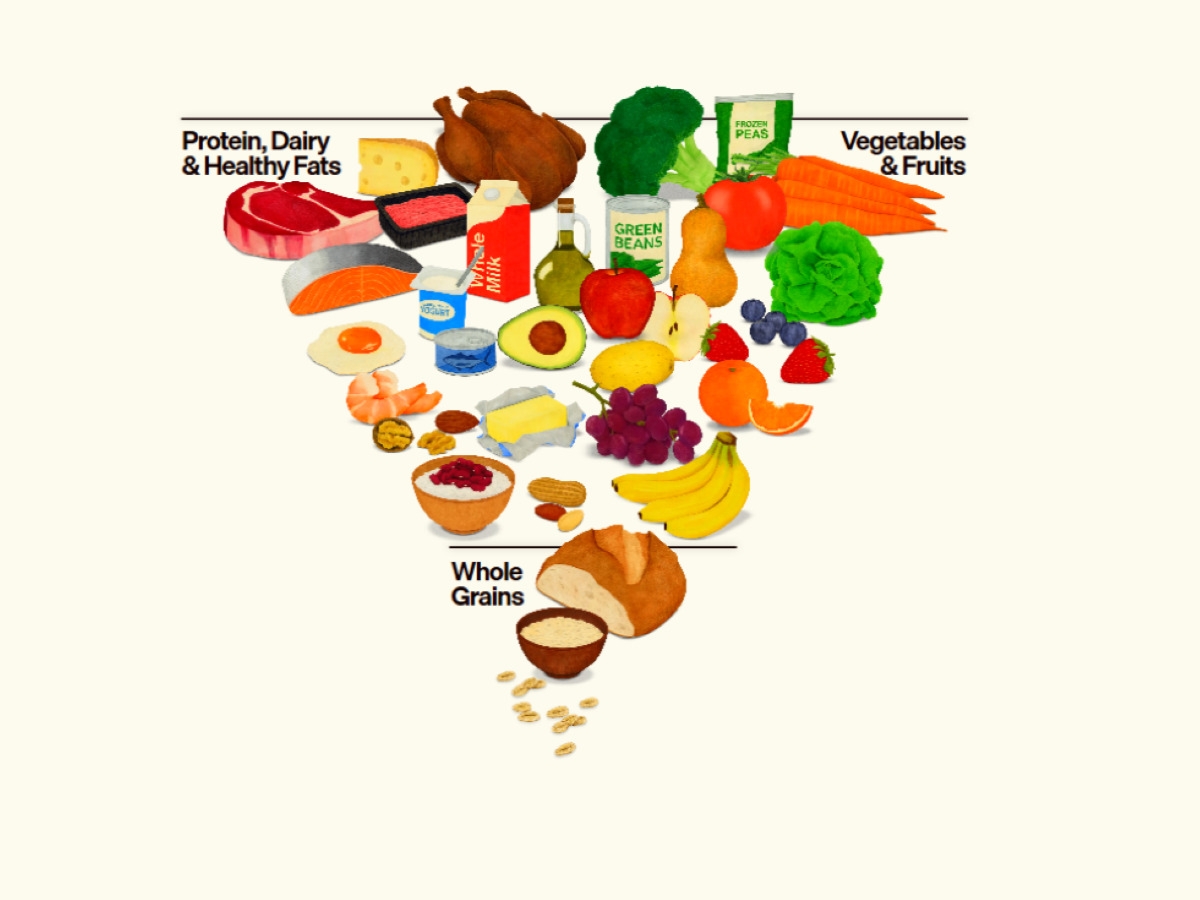
Source: Dietary Guidelines for Americans, https://realfood.gov/
At the top, starting on the left-hand side, you’ll see a ribeye steak, a large roast turkey, a thick wedge of cheese and a half a gallon of whole milk.
Compare that to the original pyramid, the rightside-up one that was introduced in the 1990s. It featured a small amount of sugars at the top; 2 to 4 servings of dairy, meat, fruits, and vegetables in the middle and 8 to 11 servings of bread, rice, pasta and other grains at the bottom. An updated version, My Plate, was issued in 2011.
The new Dietary Guidelines for Americans (DGA) have been given a thumbs-up by the American Academy of Pediatrics and the American Medical Association. Both organizations have praised the new guidelines for warning against highly processed foods: those that contain added salt, sugar, artificial flavors, petroleum-based dyes and artificial preservatives, as well as non-nutritive sweeteners in beverages. The new DGA’s “war on sugar” has also earned the seal of approval from both organizations.
The American Heart Association, though, has offered a mixed review, seeing saturated fats—promoted vigorously by the secretary of the Department of Health and Human Services (HHS)—as primary drivers of cardiovascular disease.
Red meat and full-fat dairy, all high in saturated fats, were considered no-nos in past versions of the DGA, but they occupy a privileged position at the top of the new food pyramid.
The 2025 guidelines share many common features with past versions, but they also stake out new territory. In other words, they embody both change and continuity. Let’s take a look at how the DGA have evolved over time.
The first official dietary guidelines were released in 1980, and they’ve been issued every five years since then.
Here are the main takeaways from the 1980 version:
The 1990 and 2000 DGA were largely unchanged from the 1980 guidance. In fact, until now, Americans have been advised in each successive version to limit full-fat dairy products and saturated fats from meat while consuming a more carb-heavy diet.
These priorities have changed.
The federal government issued a press release summarizing the new DGA’s main recommendations as follows:
The language used in the 1980 and 2025 versions of the guidelines may differ, but there’s actually a fair amount of overlap between the two. Both exhort the public to choose a wide variety of foods. Fruits and vegetables figured prominently on the list of healthy foods in the past, and that hasn’t changed.
The new guidelines endorse almost double the amount of protein than previously recommended. “The protein recommendation is now at 1.2 to 1.6 grams per kilogram of body weight. That’s higher than the long-standing recommendation of 0.8 grams per kilogram of body weight,” says Shonali Soans, a registered dietitian in the Division of General Internal Medicine at Weill Cornell Medicine, who specializes in integrative health and well-being.
What’s more, the messaging on healthy fats, fat sources and saturated fats could be cause for confusion and misinterpretation. The pyramid visual privileges red meat, cheese and full-fat dairy, while the guidelines still suggest that no more than 10 percent of daily calories come from saturated fats.
Giving the nod to saturated fats while restricting their consumption has left many people, including experts, flummoxed.
The guidelines acknowledge that more high-quality research is needed to determine which types of dietary fats best support long-term health.
The new food pyramid actually has two purposes. First, it’s an educational tool that prompts the public to eat more healthfully. Second, it sets standards for food procurement policy for schools and the military, along with 16 national food assistance programs. These include SNAP (food stamps), WIC (women, infants and children) and various programs for older adults.
In the U.S., 74 percent of adults are either overweight or obese. Approximately 36.4 million people have type 2 diabetes, with many more showing signs of prediabetes. The main culprits are sedentary lifestyles and the American diet, with its highly processed food, large portions and what some believe to be addictive, problematic ingredients.
The new government slogan is Eat Real Food. Information related to the new dietary guidelines appears on the website realfood.gov.
But what constitutes “real” where food is concerned? Just because a food is real doesn’t mean it’s good for everyone.
For example, bananas are eminently real, plus they’re as delicious as they are popular. They’re also rich in potassium, an essential mineral that the body needs for normal cell function. However, people with late-stage kidney disease should avoid them like the plague.
The American Heart Association advises people with medical conditions or concerns to check with their primary care physician to see which foods are safe for them.
Another real food, red meat, which is touted as healthy under the new guidelines, is harder to digest than poultry or fish, especially for older adults.
The term “real food” is a “useful shorthand to describe minimally processed, nutrient-dense foods that are free from additives and artificial ingredients,” says Shonali. “However, it can be misused. Many packaged foods use ‘natural’ on their labels while still being high in sugar and additives.”
“Eat Real Food” is a great slogan, but as individuals with different needs, we may need to go deeper to figure out what “real” means for us.
Many professional organizations have endorsed the Mediterranean diet as key to the prevention of chronic diseases and to overall health and wellness.
The American Diabetes Association (ADA) recommends it for the prevention of type 2 diabetes and cardiovascular disease.
The American Heart Association (AHA) states that the Mediterranean diet is associated with a 29 percent reduction in cardiovascular events over nearly five years in high-risk populations.
The diet discourages the consumption of red meat. It emphasizes fruits, vegetables, whole grains, legumes, nuts and seeds, with olive oil as the primary source of fat. Rich in minimally processed plant foods and monounsaturated and unsaturated fats from olives, nuts, and seeds, but low in saturated fats, the diet includes moderate amounts of fish, poultry and fermented dairy products like yogurt and kefir.
“The Mediterranean and DASH diets both emphasize whole foods, fruits, vegetables and whole grains, and both recommend limiting added sugars, highly processed foods and refined carbohydrates, so there is overlap in those areas,” Shonali says. “The new dietary guidelines and the DASH diet both recommend a <2300mg daily cap on sodium.
“However,” she continues, DASH emphasizes low-fat dairy and lower saturated fats compared to the new DGA. Mediterranean emphasizes unsaturated fats (olive oil, nuts and fish) and lower red meat consumption.“
The DASH diet is designed to lower blood pressure—a risk factor for cardiovascular disease, kidney disease and even dementia.
But the 2025 DGA wants to end the “war” on saturated fat—a goal that hasn’t been embraced wholeheartedly by the scientific community.
Seek nutrition counseling with Integrative Health and Wellbeing at Weill Cornell Medicine.

