Read about upcoming changes to UnitedHealthcare coverage.
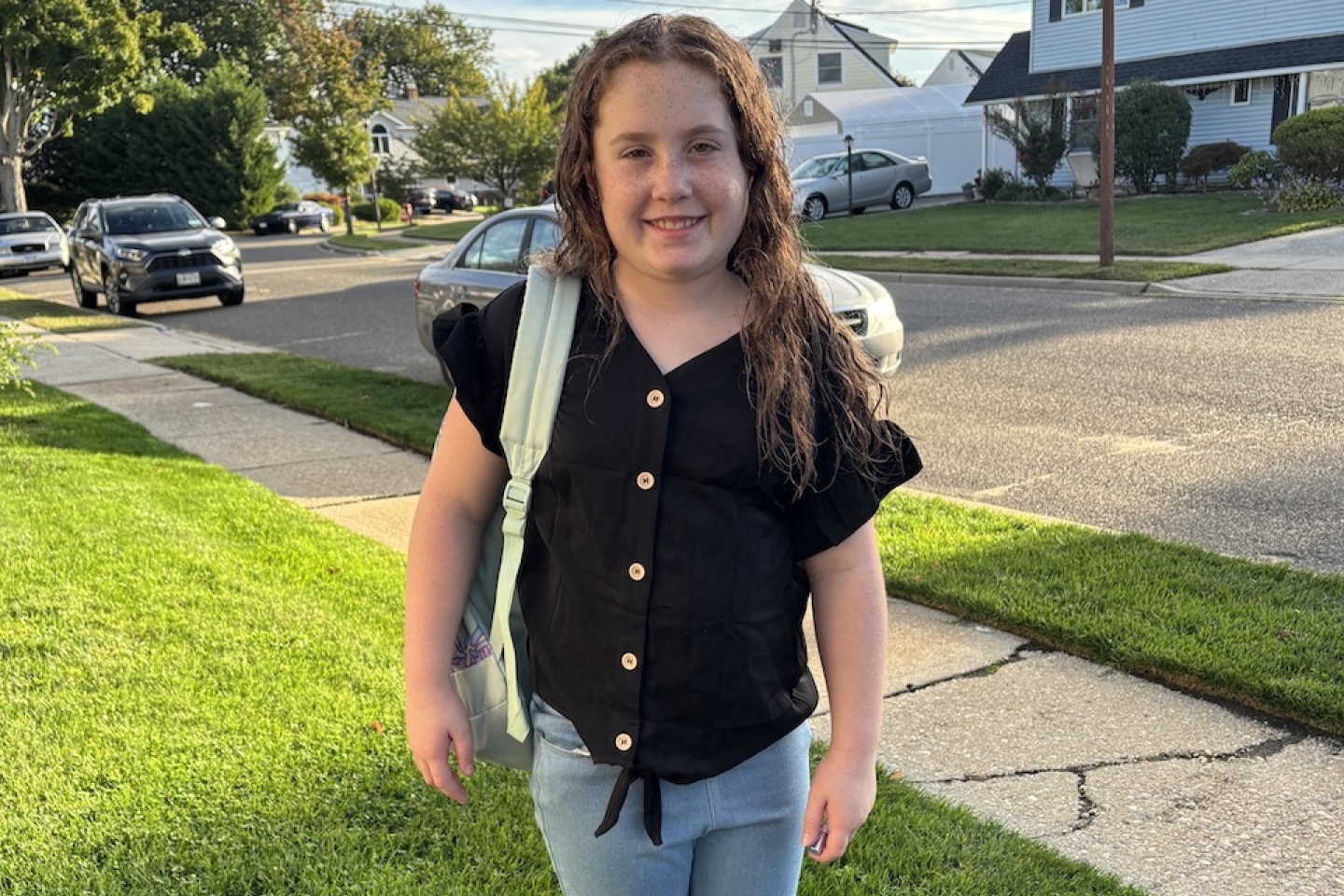
Emma Lutz is an eleven-year-old who radiates creativity and confidence. She builds elaborate Lego worlds, bakes with her mom and fills every room with warmth. But just a year ago, her family feared they might never see this version of her again.
Emma’s first seizure happened suddenly. At school, she froze in the hallway and didn’t respond for half a minute. A week later, she had a seizure in her sleep. Soon, seizures became a regular part of her life, making her feel lost and confused.
Her mother, Trisha, watched Emma pull away from the things she loved. “She didn’t trust herself anymore,” Trisha says. Emma started to seize almost every day, and her favorite activities like roller skating and swimming became scary.
Her father, Andrew, recalls the helplessness they felt. “The hardest part was not knowing where her life was going to go. We kept asking ourselves, ‘Is she ever going to get back to normal?’ We tried medication after medication, hoping each time that this would be the one. But nothing changed. We felt like we were losing her.”
Emma’s family first found hope in She Danced with Lightning, a book that tells the story of a child with epilepsy treated at NewYork-Presbyterian/Weill Cornell Medical Center. Seeking a second opinion, Emma’s parents connected with that child’s epilepsy team, pediatric neurologist Dr. Zachary Grinspan and pediatric neurosurgeon Dr. Caitlin Hoffman.
Dr. Hoffman remembers meeting Emma, who “was bright, brave and deeply thoughtful. Even in her fear, she asked smart questions. Our goal was to give her a life not defined by seizures and she had the strength to walk that path.”
The pediatric epilepsy team, coordinated by Michelle Buontempo NP, quickly became a lifeline, helping Emma feel calmer and answering all of her family’s questions. Dr. H. Allison Bender, a neuropsychologist at Weill Cornell Medicine Neurological Surgery and epilepsy specialist, helped explain how Emma’s seizures affect her cognitive function, memory, language and learning, and defined how surgery could positively impact these abilities by controlling her seizures.
As part of Emma’s evaluation, the team conducted advanced diagnostic testing, including prolonged video EEG monitoring, high-resolution MRI, neuropsychological testing, and functional imaging, to precisely map where Emma’s seizures were originating and how critical brain functions like language and memory were organized. This level of detailed testing allowed the team to confidently determine both the seizure focus and the safest surgical approach.
Surprisingly, EEGs showed Emma’s seizures came from the left side of her brain, not the right, as previous evaluations had thought. Her brain’s right side had been compensating, picking up the slack.
For Emma's parents, deciding to move forward with brain surgery was agonizing. The procedure would involve repairing a skull defect and performing a selective resection (amygdala-hippocampectomy) to remove the seizure focus.
“Hearing the words ‘brain surgery’ for your ten-year-old is incomprehensible,” Trisha says.
What ultimately gave Emma’s family confidence was the surgical team and their approach. Dr. Hoffman took time to explain each step of the procedure and how the team worked together to keep Emma safe. The clarity, coordination and compassion of the pediatric epilepsy surgery team helped Emma’s parents feel supported and secure in their decision.
After surgery, Emma woke up alert and talking. Her parents were so relieved to see signs of improvement.
Emma’s recovery wasn’t easy but within days, something shifted.
“Her attitude went back to what it was before the seizures,” Andrew says. “She was more engaged, more herself. We got our daughter back.”
Emma remembers feeling “like I could finally do things again. I wasn’t scared anymore.”
Today, Emma is thriving and making new friends. She swims without fear and goes on zipline courses. After surgery, Emma laughs more and trusts her body again.
“This is the longest she’s ever gone without a seizure,” Andrew says. “Every milestone feels like a miracle.”
Emma’s family now sees life differently. Their message to other families facing pediatric epilepsy surgery is simple and powerful: “It’s scary, but it can change everything. Trust the professionals. Don’t give up hope.”
Emma’s journey is a testament to what’s possible when expert care meets extraordinary courage. Dr. Hoffman explains: “Emma reminds us why we do this work. She is living proof that there is always hope.”
For families ready to take the next step, the experts in pediatric epilepsy surgery at Weill Cornell Medicine can help guide you through diagnosis and treatment planning. Find out more about epilepsy surgery and connect with our team today.

