Read about upcoming changes to UnitedHealthcare coverage.
How artist Scott Albrecht turned a traumatic brain injury into a meditation on what holds us together
As typographic artist, Scott Albrecht spends his life thinking about the relationship between words and images — how a message can carry feeling, how text can be transformed from something you read into something you simply experience. What he didn’t anticipate was that one August morning in 2023 near his studio in Brooklyn, his own life would start a chapter he’d have to piece together from other people’s images and accounts.
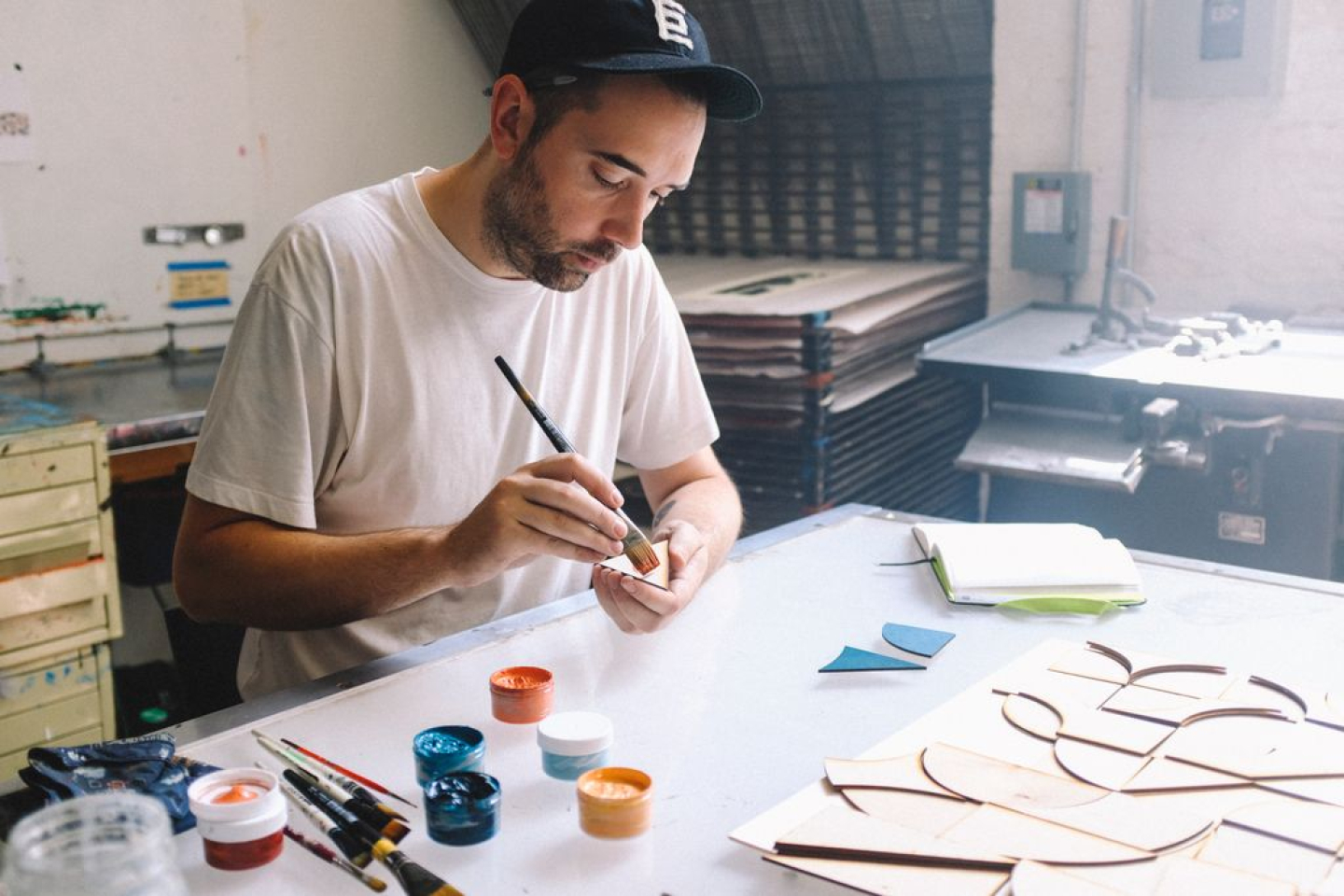
Scott’s bold, abstract art appears in galleries and on the sides of buildings. He’s collaborated with brands like Google, Spotify and Vans, and spent years transitioning from a career in graphic design to full-time artistic practice. On the morning of his life-altering accident, Scott was 40, active and excited to dive into work. He was doing something ordinary: skateboarding to a nearby Lowe’s, hands full with a piece of plywood he needed to return. When he fell, he couldn’t brace himself. The impact went straight to his head.
The fall caused his brain to swell. When he arrived at NewYork-Presbyterian Brooklyn Methodist Hospital, Weill Cornell Medicine assistant professor of neurosurgery Dr. Ibrahim Hussain performed an emergency craniectomy — the removal of part of his skull — to relieve the pressure. Scott was induced into a coma. He doesn’t remember any of it. Dr. Hussain was concerned he might not survive the extensive brain injury he suffered. “I had a frank discussion with his wife, because if he did survive, we wouldn’t know the extent of any permanent neurologic problems,” he says. He wasn’t sure Scott could recover from such a catastrophic event.
“Something happened that caused me to fall,” he says simply. “Anything I can say about it is really just a composite of other people’s accounts, an ambulance report, surveillance footage and things my studio mates saw.” The post-traumatic amnesia that followed lasted about two weeks. For that stretch, every morning in the ICU was a reset. He knew the hospital was near his studio, and he kept trying to leave.
Scott spent approximately four and a half weeks in the hospital at NewYork-Presbyterian Brooklyn Methodist. He rebuilt his ability to walk almost from scratch, since his muscles were weak from so much time in bed. It wasn’t an easy time, since Scott’s fatigue was pervasive. Even short conversations left him depleted. When he was discharged, he couldn’t walk without a cane.
Weeks later, he underwent a cranioplasty at NewYork-Presbyterian/Weill Cornell Medical Center on the Upper East Side, where a polymer plate was put in place of the missing bone. The relief was immediate. The surgery alleviated the constant pain whenever he was upright and allowed him to redirect his energy toward rebuilding in earnest: physical therapy, occupational therapy and slowly returning to his studio.
Dr. Hussain was blown away by Scott’s recovery. “In just a few months, he walked back into my office, conversant and pleasant, without any obvious neurological deficits or weakness,” he says. “It was remarkable to see him recover.”
The physical recovery moved faster than the medical team expected. Scott credits this largely to the fact that he couldn’t comprehend the severity of what he’d survived. “I just thought: I have to walk, I have to keep going,” he says. What came more unexpectedly was the cognitive and emotional reckoning.
Scott dealt with depression, overwhelm and emotional flooding, which showed up as waves of intense feeling with no apparent trigger. His life had transformed in an instant, cleaved into “before” and “after.” He’d be making breakfast and suddenly be overcome with tears. He managed the changes as they came up, like his new intolerance for violent content and losing his sense of smell, which also affected his sense of taste. His perception of color also appears to have shifted; looking at his own earlier work, he can’t see the subtleties that used to stand out to him.
And yet, running through all of it was something Scott kept reaching toward: meaning. He was committed to making meaning of the experience and extracting something worth holding onto.
About a year and a half after the accident, he mounted a gallery exhibition titled “What Holds Us.” The show drew from the experience of injury and recovery. The work focused on universal themes: support, love, gratitude, acceptance and the ways people navigate situations they never asked for. He wrote a book for the exhibition to accompany the pieces. The response he received confirmed what he’d hoped: visitors came back to him with their own stories. Strokes. Significant illnesses. Losses. A kind of shared humanity that lives beneath the specific symptoms and circumstances.
“I wanted to make an artifact of something worth being reminded of,” he says. “Nobody wants to live with a bad mood. But even in the most challenging situations, I think there’s something worth taking away.”
He returned to the hospital to give copies of his book to every member of the care team he could find. Two years later, his providers still remembered him. A few came out from other floors when they heard he was there. “A lot of times, you go to the hospital, you leave, and that’s it,” he says. “Being able to go back and say — you saved my life, and here’s what came of it — that was one of the most cathartic things I’ve done.”
Dr. Hussain was incredibly touched when Scott returned to share his book. “It absolutely blew me away when he came back to see me and showed me his artwork. He turned something so traumatic into something so beautiful,” he says. “His art is a testament to the ER doctors, the nurses, the PAs and the therapists, among others, that were all part of his care.”
Scott still skateboards, though not on the street. He still makes art. But now, he says “I love you” at the end of phone calls with his friends, and they say it back. He doesn’t take anything for granted.
Dr. Ibrahim Hussain is an assistant professor of neurosurgery at Och Spine at NewYork-Presbyterian at the Weill Cornell Medicine Center for Comprehensive Spine Care. Dr. Hussain is the current Leonard and Fleur Harlan Clinical Scholar. Learn more about Dr. Hussain’s work and book an appointment here: https://weillcornell.org/ibrahim-hussain-md

